


Zhenyu Guo
Ph.D. | Virtual sound reproduction | Digital hearing health
Communication Acoustics
The science of how sound is produced, propagated, received, analyzed, and understood
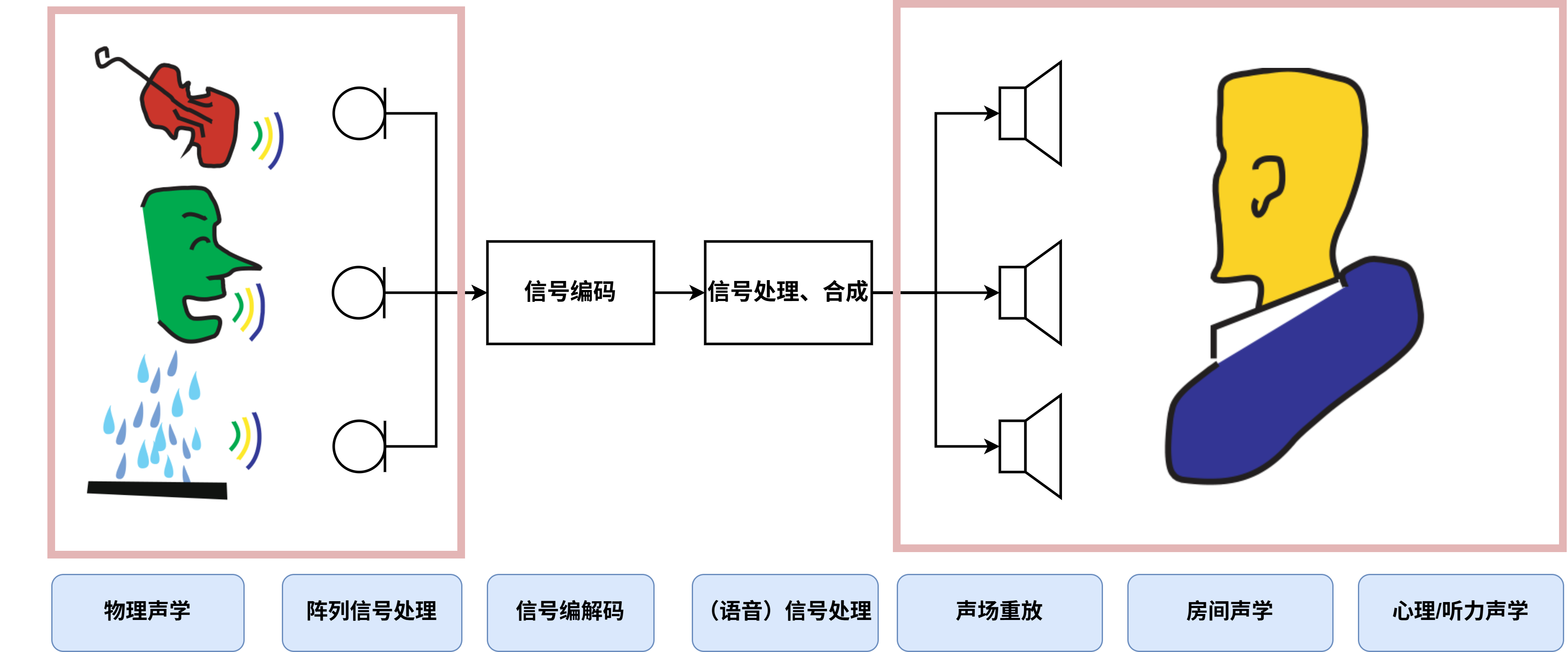
Modified from: Pulkki, V., Karjalainen, M., 2015. Communication acoustics: an introduction to speech, audio and psychoacoustics. John Wiley & Sons.
Virtual Sound Reproduction#
One of the ultimate propositions of communication acoustics is to provide users with auditory experiences in virtual environments similar to those in real environments (the same auditory events) through digital signal processing technology and corresponding hardware.
Virtual sound reproduction is a key technology in virtual reality (VR) audio implementation. Using multi-channel audio processing algorithms, it achieves spatial virtual sound fields through headphones or multi-channel loudspeakers. Combined with human factors research in the digital hearing field, targeted experiments are designed to verify the perceptual experience of normal-hearing individuals, hearing-impaired individuals, and other groups under virtual reality auditory conditions. Achieving high-quality virtual sound experience
The key technologies include: high-precision sound propagation simulation/modeling, efficient, accurate and stable multi-channel audio processing algorithms, and clear auditory perception mechanisms and evaluation methods.
Digital Hearing Health#
At the receiving end of sound (humans), the health status of the auditory system directly affects the auditory experience, and individual differences also lead to different auditory perceptions. Through digital signal processing technology, combined with research in audiology and psychoacoustics, personalized auditory health solutions are designed and implemented. This is not only about protecting auditory health, but also a key to enhancing the overall auditory experience.
flowchart LR
  A[Sound Information] --> B[Sound Perception]
  B --> C[Determine Auditory Status]
  C --> D[Hearing Assistance]
  D --> A